
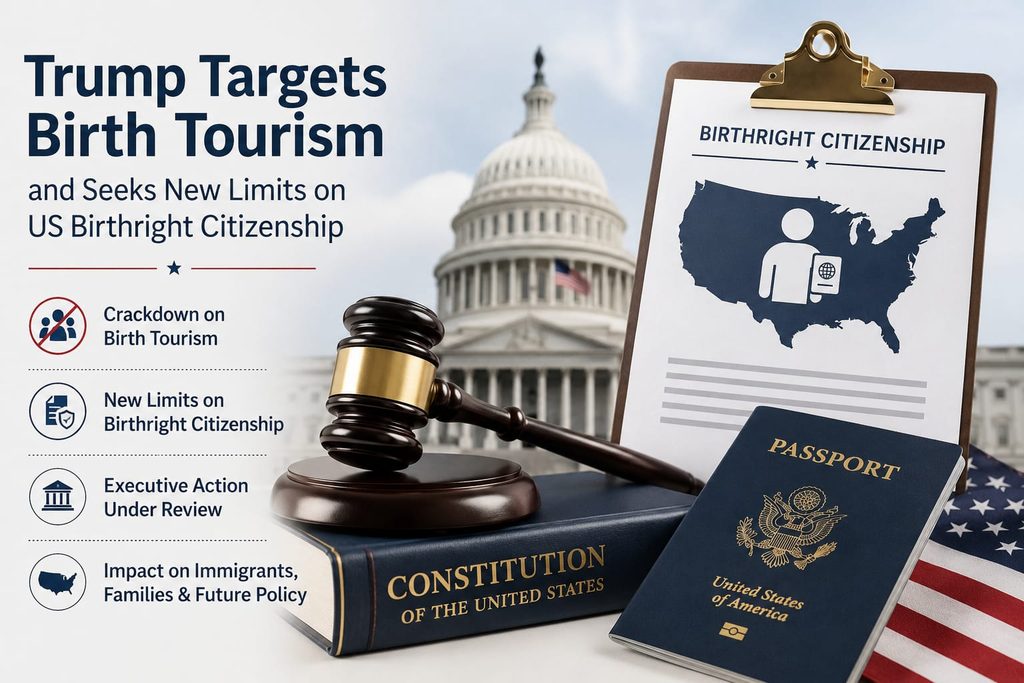
President Donald Trump has reopened the battle over birthright citizenship with two executive orders signed on August 6, 2026, taking a narrower approach after the Supreme Court rejected his earlier attempt to restrict citizenship by birth. The new measures target four specific categories of children born in the United States and introduce tougher measures against birth tourism.
Four Categories Targeted by the Citizenship Order
The citizenship order applies only when neither parent is a US citizen and identifies four categories of children who may be denied recognition of US citizenship.
These include children of an alien enemy, children of certain foreign government employees, children whose parents engaged in a commercial transaction to obtain or access birthright citizenship, and children born in certain US territories or territorial waters where federal law does not provide citizenship.
The order is narrower than Trump’s previous Executive Order 14160, which would have affected a much broader group of children, including those with parents who were lawful permanent residents.
Payment for Birthright Citizenship
The most significant new element concerns parents who engage in a commercial transaction to obtain or access birthright citizenship for their child.
The order specifically refers to paying to bring a mother into the United States or one of its territories to give birth, as well as paying a surrogate who is present in the United States. Surrogacy had not previously played a central role in the administration’s birthright citizenship dispute.
The administration is effectively treating such payments as a form of fraudulent or improper access to citizenship rather than challenging the child’s constitutional status directly.
Crackdown on Birth Tourism
The second executive order targets birth tourism, including cases where a foreign national enters the United States on a nonimmigrant visa primarily to give birth.
Federal authorities may deny or revoke visas, impose permanent entry bars, remove individuals involved in birth tourism, and take action against organizations that facilitate the practice. Humanitarian and national-interest exemptions remain available at the discretion of the relevant authorities.
Much of this enforcement framework already exists. A 2020 State Department rule established a ground of inadmissibility for visitors traveling primarily to give birth, while applying for a visa solely to obtain citizenship for a child has long been associated with fraud and misrepresentation.
Birth Tourism Estimates
There is no official nationwide count of birth tourism in the United States. CDC data recorded nearly 9,600 births in 2024 to mothers reporting an address outside the United States and its territories, compared with approximately 3.6 million births nationwide.
The Center for Immigration Studies estimates that between 22,000 and 26,000 births annually may involve birth tourism, although the Migration Policy Institute considers this estimate contested. Reported birth tourism packages range from approximately US$20,000 to US$100,000.
Implementation and Legal Challenges
Federal agencies have 30 days to publish guidance on implementing the new citizenship order. Enforcement responsibilities will involve the Secretary of State, Attorney General, Secretary of Homeland Security, and Commissioner of Social Security.
The orders do not specify a clear effective date or expressly state whether they apply only to future births, leaving questions about their potential reach. Both orders also contain severability clauses, allowing individual provisions to potentially survive if courts strike down other parts.
Legal challenges are expected. Critics argue that an executive order cannot change the constitutional meaning of the Fourteenth Amendment and that the citizenship claim belongs to the child rather than the parents.
What the Orders Mean for Birthright Citizenship
The latest measures do not abolish birthright citizenship in the United States. Instead, they attempt to restrict recognition of citizenship in a limited number of circumstances while placing greater pressure on birth tourism and related arrangements.
The administration’s approach marks a shift from directly attempting to redefine birthright citizenship toward targeting specific conduct surrounding a child’s birth. Whether these narrower measures can withstand constitutional and statutory challenges will ultimately depend on the courts.
Summary
Trump’s latest executive orders do not directly challenge the Supreme Court’s interpretation of the Fourteenth Amendment. Instead, they seek to limit citizenship in narrowly defined circumstances, including cases involving foreign government employees, designated alien enemies, and parents who pay to access birthright citizenship through birth tourism or surrogacy arrangements.
The companion order, Ending Birth Tourism, also directs federal authorities to use existing immigration powers to deny visas, revoke visas, impose entry restrictions, remove individuals involved in birth tourism, and take action against organizations facilitating the practice. The measures are expected to face legal challenges, with critics arguing that an executive order cannot alter the constitutional guarantee of birthright citizenship.

