
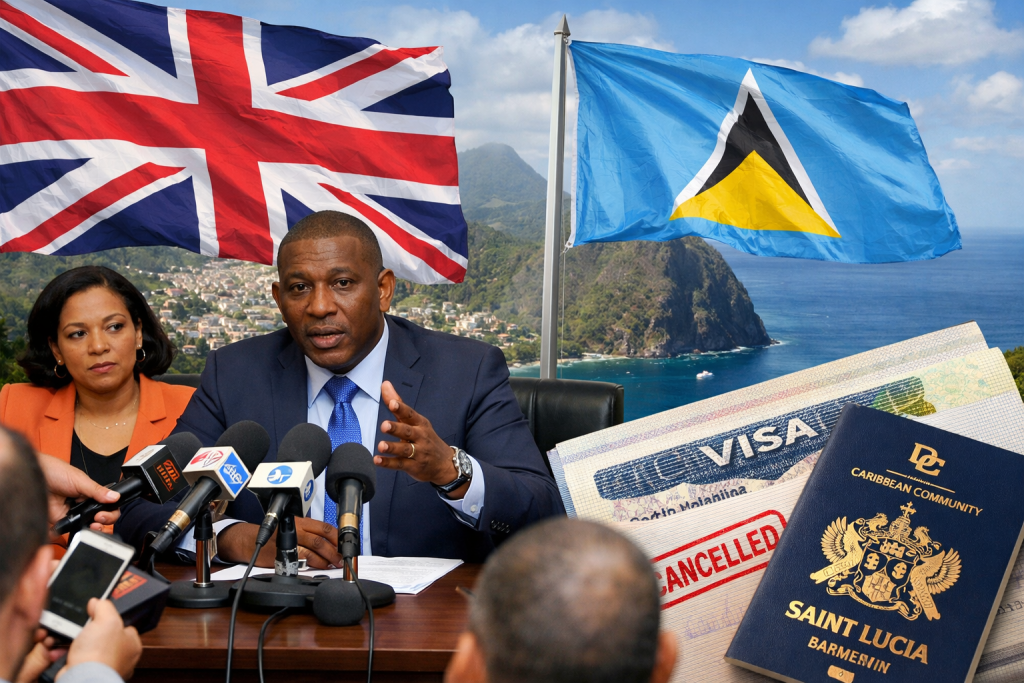
The government of Saint Lucia has responded to the United Kingdom’s decision to suspend visa-free travel for its citizens, rejecting claims that the country’s citizenship-by-investment program is responsible for the move. Officials argue that the issue is related to individual immigration behavior rather than systemic problems with the program itself, while the UK maintains concerns about risks associated with investment citizenship.
1. Government Response to the UK Decision
Officials in Saint Lucia strongly rejected claims that the country’s **Citizenship by Investment Program (CIP) caused the United Kingdom to suspend visa-free travel. Prime Minister Philip J. Pierre and Deputy Prime Minister Ernest Hilaire both stated that the government has no intention of stopping the program and will continue strengthening it despite the new visa requirement.
2. UK Concerns Over Asylum Claims
According to a letter from Mike Tapp, the UK Minister for Migration and Citizenship, the decision was mainly driven by an increase in asylum claims by travelers using Saint Lucian passports. The UK reported that some individuals entered as visitors but later applied for asylum, which raised concerns about pressure on the British immigration system.
3. Saint Lucia Rejects the Link to CIP
Deputy Prime Minister Ernest Hilaire argued that there is no evidence connecting asylum claims to citizenship-by-investment applicants. He noted that UK statistics do not distinguish between natural-born citizens and those who obtained citizenship through investment, and he asked the UK government to provide detailed data if any CIP citizens were involved.
4. UK’s Official Position on Investment Citizenship
Despite Saint Lucia’s position, the UK government’s official memorandum described investment citizenship programs as “inherently high-risk.” British authorities also highlighted that Saint Lucia’s program experienced rapid growth, with thousands of applications in recent years, which they believe coincided with increased cases of people entering the UK and later claiming asylum or working illegally.
5. Transition Period and Wider Implications
The UK introduced a six-week transition period allowing travelers who already obtained an ETA before March 5 to enter visa-free until April 16, 2026. Saint Lucia is now the second Caribbean country to lose visa-free access to the UK after Dominica, while the United States has also tightened visa policies for several Caribbean citizenship-by-investment countries..
Summary
Saint Lucia’s leaders denied that the citizenship-by-investment program caused the UK to impose visa requirements, emphasizing that the program will continue. The UK, however, cited rising asylum claims and security concerns linked to investment citizenship. While Saint Lucia insists there is no evidence directly connecting CIP applicants to these issues, the situation reflects growing international scrutiny of Caribbean citizenship-by-investment programs and their impact on visa-free travel agreements.

