
Saint Kitts and Nevis has taken a revolutionary step toward digital transparency by adopting blockchain technology within its Citizenship by Investment (CBI) due diligence framework. This pioneering integration marks a significant milestone in the evolution of global investment migration, positioning the twin-island nation as a trailblazer in ethical governance, data security, and compliance.
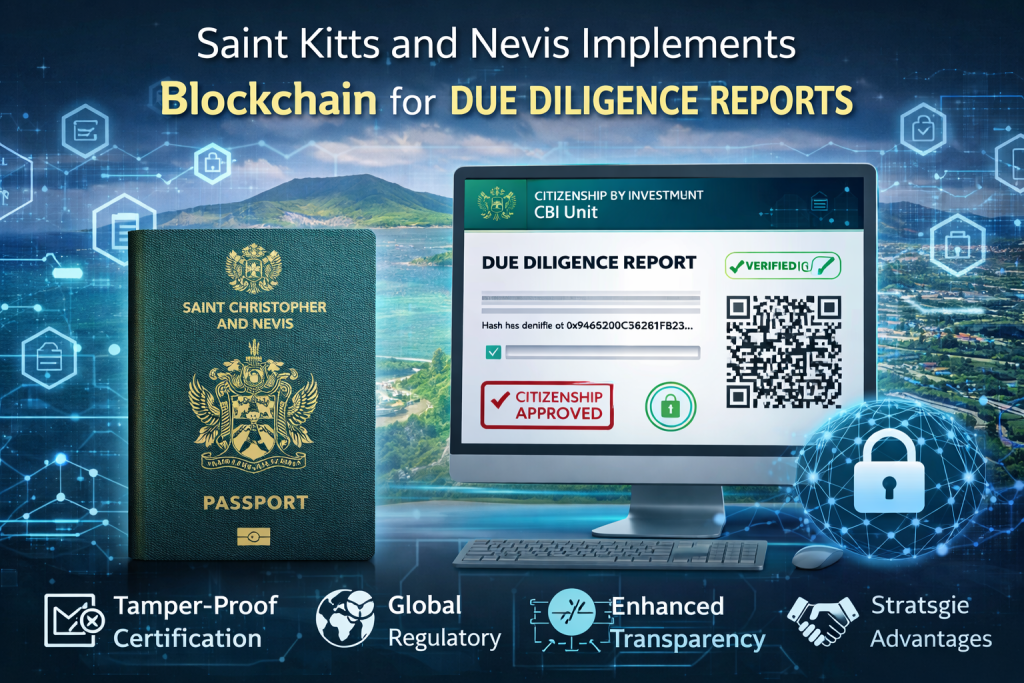
By leveraging blockchain, Saint Kitts and Nevis ensures that each due diligence report carries a unique, tamper-proof digital identity, permanently recorded on a secure distributed ledger. This digital record can be instantly verified via a protected online portal, offering unprecedented transparency and accountability for applicants, governments, and authorized partners.
Understanding Blockchain-Verified Due Diligence
How Blockchain Strengthens the Verification Process
Blockchain technology functions as an immutable digital ledger, designed to store and authenticate data across a decentralized network. In the context of the Saint Kitts and Nevis CBI Program, this system securely records and verifies each due diligence report, providing a traceable and incorruptible record of its authenticity.
Once a due diligence report is created, it is assigned a unique cryptographic hash — a digital fingerprint that confirms its origin and content integrity. This hash is stored on the blockchain, ensuring that any subsequent attempt to alter or forge the document would be immediately detectable.
This mechanism eliminates the risk of fraudulent documentation and reinforces the integrity of the CBI application process.
Key Benefits of Blockchain-Based Certification
1. Authenticity and Reliability
The blockchain-verified certification system directly addresses concerns about document forgery, alteration, or misrepresentation. By embedding each due diligence report into an immutable blockchain network, the government ensures that:
- Every document is genuine and verifiable in real-time.
- Authorized institutions can confirm legitimacy instantly through a secure verification portal.
- The risk of data manipulation or unauthorized access is effectively eliminated.
This new layer of trust enhances confidence among investors, due diligence agencies, and international regulators.
2. Compliance with Global Regulatory Standards
In an era of increasing scrutiny, compliance with international standards is essential. The Saint Kitts and Nevis CBI Unit has ensured that its blockchain system aligns with:
- General Data Protection Regulation (GDPR) for data privacy.
- Anti-Money Laundering (AML) and Counter-Terrorist Financing (CTF) protocols.
- OECD and FATF global governance benchmarks.
This alignment reflects Saint Kitts and Nevis’s commitment to responsible investment migration, ensuring that the country’s CBI operations remain transparent, ethical, and globally compliant.
3. Enhanced Due Diligence Structure
The integration of blockchain complements existing multi-layered due diligence mechanisms already in place within the program, including:
- Comprehensive financial and background checks on applicants.
- Advanced biometric verification for identity authentication.
- Sanctions and politically exposed person (PEP) screening to ensure compliance with global watchlists.
By merging these traditional due diligence tools with blockchain verification, Saint Kitts and Nevis establishes one of the most robust vetting frameworks in the citizenship by investment industry.
Significance of Blockchain in the CBI Industry
A Global Benchmark for Transparency
The introduction of blockchain-certified due diligence positions Saint Kitts and Nevis as one of the first CBI jurisdictions to fully operationalize this advanced technology. This landmark move highlights the country’s leadership in digital governance and sets a new global standard for transparency and security in investment migration programs.
Get ROC Citizenship’s stories in your inbox
Join Medium for free to get updates from this writer.Subscribe
By integrating distributed ledger technology, the country reinforces its role as a trusted CBI destination, ensuring that investors and regulators alike can rely on the authenticity of every approved application.
Ethical Governance and Investor Confidence
Saint Kitts and Nevis has long been recognized for its ethical approach to investment migration. With blockchain verification, the government enhances this reputation by ensuring accountability at every stage of the application process.
Investors can now apply with greater confidence, knowing that their applications are being handled under a verifiable, fraud-resistant system. This not only safeguards the reputation of the CBI program but also attracts high-net-worth individuals seeking legitimate and secure investment routes to second citizenship.
Strengthening International Collaboration
Blockchain verification also enhances cross-border collaboration between governments, financial institutions, and due diligence firms. Since all verified reports are digitally accessible via a secure online portal, authorized partners can instantly confirm the authenticity of documentation without relying on intermediaries or manual verification.
This fosters efficiency, trust, and interoperability, reducing administrative burdens and enabling faster decision-making across global jurisdictions.
Technical Overview: How Blockchain Secures the Process
1. Data Encryption and Digital Identity
Each due diligence report is encrypted and assigned a unique digital signature before being uploaded to the blockchain. This ensures the report’s content integrity and prevents tampering or unauthorized replication.
2. Distributed Ledger Storage
Rather than storing information on a single centralized database, blockchain distributes the record across multiple network nodes. This decentralized structure guarantees that no single entity can manipulate or delete the data.
3. Immutable Audit Trail
Every verification action — whether viewed, validated, or updated — is logged permanently. This immutable audit trail allows authorized parties to trace the entire lifecycle of a due diligence report, strengthening transparency and accountability.
Strategic Advantages for Saint Kitts and Nevis
Positioning as a Digital Governance Pioneer
By integrating blockchain into its CBI framework, Saint Kitts and Nevis not only enhances data security and operational efficiency, but also establishes itself as a leader in digital governance innovation. This strategic move strengthens the nation’s competitive advantage in the global investment migration market.
Attracting Quality Investors
The enhanced transparency and security of the blockchain-backed due diligence process appeal particularly to ethical investors and reputable intermediaries. This attracts applicants who prioritize integrity and compliance, further improving the quality and credibility of the program.
Boosting International Reputation
Adopting blockchain verification elevates the global perception of the Saint Kitts and Nevis CBI Program. It demonstrates the country’s dedication to trust, innovation, and global alignment, reinforcing its position among the most respected CBI jurisdictions worldwide.
Looking Ahead: The Future of Blockchain in Investment Migration
The successful integration of blockchain into Saint Kitts and Nevis’s CBI program paves the way for broader adoption across the industry. Other nations are expected to follow suit, recognizing the value of digital verification in strengthening compliance and improving global trust.
In the coming years, blockchain could extend to passport issuance, applicant tracking, and residency management, transforming how governments manage and safeguard sensitive migration data.
Conclusion
The introduction of blockchain-verified due diligence reports by Saint Kitts and Nevis represents a landmark achievement in digital transparency and security. By merging cutting-edge technology with global compliance standards, the country redefines what it means to operate a trusted, ethical, and future-ready CBI program.
This initiative reinforces Saint Kitts and Nevis’s role as a pioneer in innovation, governance, and global collaboration, setting a model that will shape the future of citizenship by investment worldwide.

