
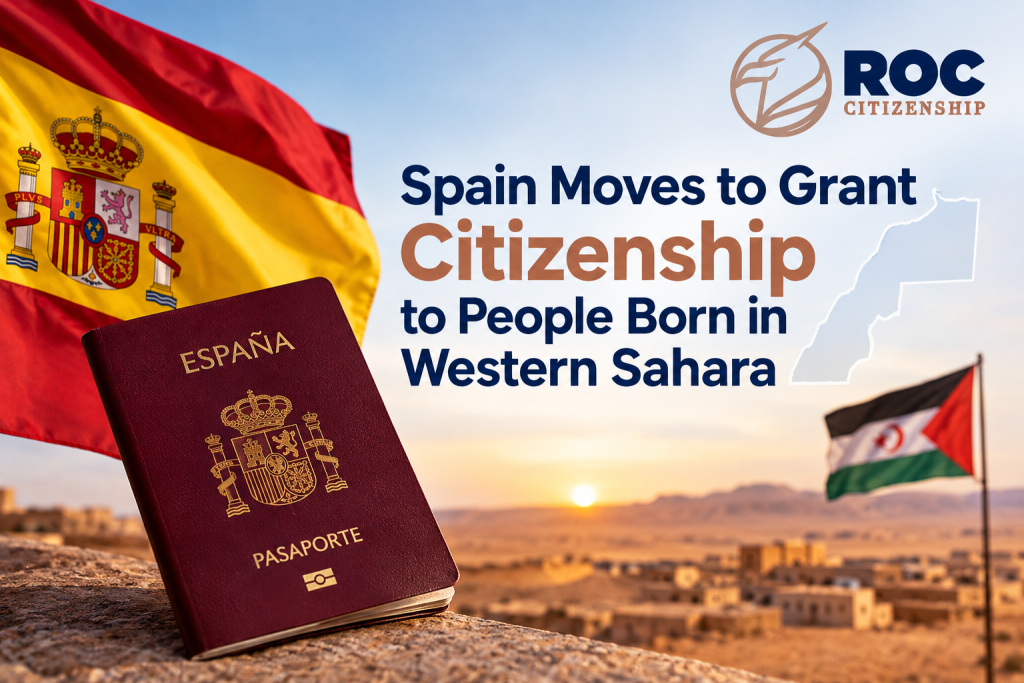
Spain’s Congress of Deputies has approved a bill that would give Spanish nationality to people born in Western Sahara before September 29, 1977, when the territory was under Spanish administration. The bill would provide a direct route to Spanish and EU citizenship without requiring residence in Spain. It now moves to the Senate for consideration.
Congress Approves the Bill
The Spanish Congress approved the bill by 168 votes to 31, with 145 abstentions. The proposal is mainly aimed at Sahrawis who were born in Western Sahara during the period of Spanish administration.
The number of potential beneficiaries is estimated at around 70,000 people, and could reach nearly 200,000 when descendants are included.
How the Citizenship Route Would Work
The bill would allow eligible applicants to obtain nationality through “carta de naturaleza,” a discretionary Spanish naturalization procedure based on exceptional circumstances.
Applicants would not need to live in Spain, and applications would be free of charge. Authorities would have up to one year to make a decision.
Applicants could prove their eligibility through documents such as:
- Spanish identity documents, including expired ones
- Birth certificates
- Documents from the former Spanish colonial administration
- UN-authenticated census documents
- School, pension, or medical records
Eligibility and Descendants
The main eligibility requirement is being born in Western Sahara before September 29, 1977.
First-degree descendants of people who obtain Spanish nationality under the new law would also have a five-year period to opt for nationality after their parent is registered in the Spanish Civil Registry.
However, grandchildren would not be included under this provision.
The application period would last three years, with the possibility of a one-year extension.
A Separate Two-Year Residency Route
The bill would also permanently amend Spain’s Civil Code to reduce the required legal residence for Sahrawis from 10 years to two years. This would place them in the same accelerated naturalization category as nationals of Ibero-American countries, Andorra, the Philippines, Equatorial Guinea, Portugal, and certain other groups.
Part of Spain’s Broader Citizenship Policy
The proposal follows a broader Spanish trend of creating special citizenship routes for specific historical groups. Previous legislation provided nationality routes for descendants of Sephardic Jews expelled from Spain and descendants of people affected by the Spanish Civil War and Franco-era exile. Spain also granted nationality to a record 299,732 foreign residents in 2025, showing the country’s increasingly significant role in EU naturalization.
Political Controversy
The bill has created political divisions in Spain.
The Sumar party strongly supports the proposal, while the Socialist Party (PSOE) initially opposed it before negotiating changes.
The People’s Party (PP) abstained, arguing that Sahrawis should use the existing two-year residence route instead of receiving nationality directly through carta de naturaleza.
The far-right Vox party voted against the bill.
Supporters describe it as a way to correct a historical injustice, while opponents argue that it could create a large new group of Spanish voters and potentially affect Spain’s migration and political landscape.
Relations with Morocco and Western Sahara
The timing is politically sensitive because Morocco claims sovereignty over Western Sahara, while Spain changed its position in 2022 and began supporting Morocco’s autonomy proposal for the territory. The citizenship bill therefore creates a tension between Spain’s domestic citizenship policy and its current foreign policy toward Morocco and Western Sahara.
The EU Citizenship Dimension
Spanish nationality automatically provides EU citizenship. This means that anyone receiving Spanish nationality under the proposed law would also gain the right to live and work in other EU member states. Although nationality is decided by each individual EU country, the other 26 EU member states could be affected because new Spanish citizens would have EU-wide mobility rights.
This has raised concerns that the law could create migration and political tensions with other EU countries, particularly Italy, which has already criticized Spain over the recent Ceuta migration crisis.
What Happens Next?
The bill now goes to the Spanish Senate. The opposition People’s Party holds enough seats to block or amend the bill there, although the Congress can ultimately override a Senate veto with an absolute majority.
If the bill becomes law, it would take effect four months after publication in Spain’s Official State Gazette.
Summary
Spain is moving toward a new citizenship route for people born in Western Sahara before September 29, 1977, potentially giving tens of thousands of Sahrawis Spanish and EU citizenship without requiring residence in Spain. First-degree descendants could also benefit under certain conditions, while Sahrawis who do not qualify for the special route would have access to a reduced two-year residency requirement. The proposal still needs to pass the Senate and could face political and legal challenges before becoming law.

