
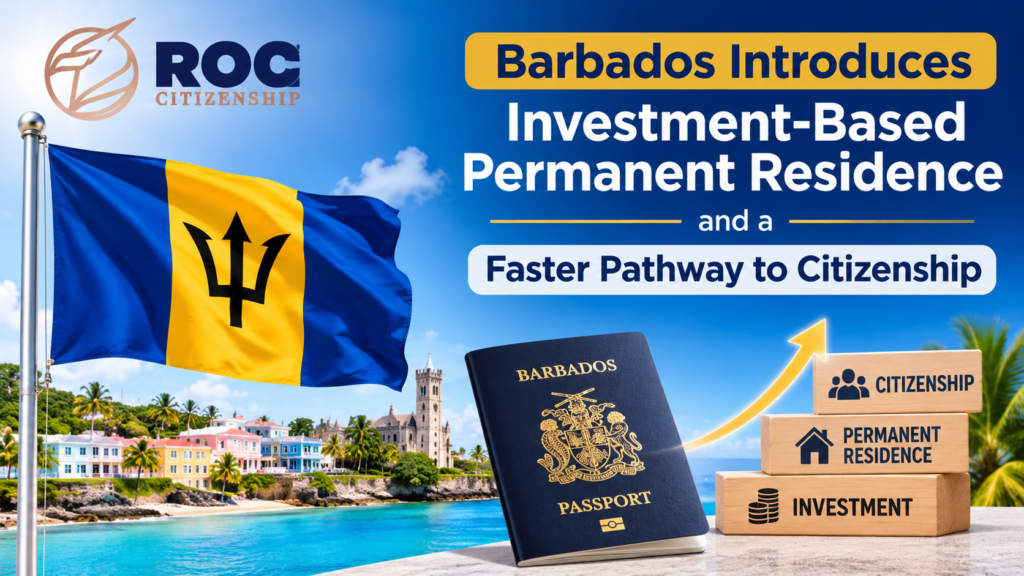
Barbados is introducing a new immigration framework that allows foreign investors to obtain permanent residence through qualifying investments, while also creating a shorter physical-residence requirement for permanent residents seeking citizenship. The Immigration Bill and its companion Citizenship Bill were passed by the House of Assembly on October 27, 2026, and have been referred to the Senate. The proposed framework aims to attract foreign capital and address the country’s demographic and workforce challenges without establishing a citizenship-by-investment programme.
Investment-Based Permanent Residence
Under Section 10 of the Immigration Bill, foreign nationals may apply for permanent residence by investing at least BBD 5 million (approximately US$2.5 million) in an approved national development project. Projects must serve a public purpose and contribute to Barbados’s development. Expected sectors include healthcare, education, housing, renewable energy, infrastructure, technology, agriculture, and tourism. The legislation also allows qualifying projects to take different forms, including funds, programmes, assets, and other initiatives.
A second route allows applicants to qualify through a points-based system. The standard requirement is five years of continuous lawful residence, but applicants who have spent at least 180 days in Barbados during the previous three years may offset the residence shortfall through investment and other qualifying points. Investments in approved national projects can earn up to eight points, while designated private-business investments can also contribute. Additional points are available based on age, Barbadian ancestry, and diplomatic or international service.
A Shorter Pathway to Citizenship
The companion Citizenship Bill introduces a reduced physical-presence requirement for permanent residents applying for citizenship registration. Non-CARICOM nationals, including their spouses and dependents, may apply after completing 360 days of physical residence within the 1,460 days immediately preceding the application. CARICOM nationals benefit from a lower threshold of 270 days within the preceding 1,095 days.
However, citizenship registration remains discretionary. The Minister may refuse an application on national security or public policy grounds, where the applicant has received a criminal sentence of at least 12 months, or where the applicant does not have sufficient financial means. Although the bills do not expressly exclude investment-based permanent residents from applying, qualifying for permanent residence does not automatically grant citizenship.
Additional Immigration and Citizenship Reforms
The wider legislative package abolishes the existing immigrant status and introduces direct permanent residence eligibility for certain family members of Barbadian citizens, individuals with five years of lawful residence, and people who have rendered exceptional service to the country.
It also establishes a new Qualifying Resident Permit of up to five years for individuals with pending or potential applications or a genuine long-term connection to Barbados. Time spent in the country under the Welcome Stamp remote-work visa will count as lawful residence toward permanent residence.
The Citizenship Bill further expands eligibility for registration to include grandchildren and great-grandchildren of Barbadian citizens born abroad. Both bills also introduce stricter work-permit requirements and stronger penalties for document fraud and migrant smuggling.
Why Barbados Is Introducing These Changes
The reforms come amid demographic pressures, including a declining birth rate and an ageing population. Barbados recorded 3,642 births against 2,444 deaths in 2000, compared with 1,995 births and 3,088 deaths in 2024. The government views immigration and foreign investment as important tools for supporting economic growth, strengthening the workforce, and addressing population decline.
The timing is also significant for the Caribbean region. Several established CBI jurisdictions are facing pressure from the European Union to phase out their programmes to protect visa-free access to the Schengen Area. Barbados is taking a different approach by offering investment-based residence rather than the direct sale of citizenship, with physical presence and ministerial discretion remaining part of the citizenship process.
What Happens Next?
Although both bills have passed the House of Assembly, they still require Senate consideration. Their provisions will take effect through proclamation, while further regulations must establish details such as fees, application procedures, investment periods, and approved project designations. Therefore, the framework is not yet operational, and applications cannot be submitted until the necessary legal and administrative arrangements are in place.
Summary
Barbados is establishing a new investment-based permanent residence framework, with a minimum investment of BBD 5 million (approximately US$2.5 million) in an approved national development project, alongside a points-based qualification route. The Citizenship Bill introduces a shorter physical-presence requirement of 360 days for non-CARICOM nationals and 270 days for CARICOM nationals within the specified look-back periods. The reforms aim to attract investment and address demographic challenges while maintaining a distinction between residence and citizenship. Both bills have passed the House of Assembly but remain subject to Senate consideration, proclamation, and implementing regulations.

