
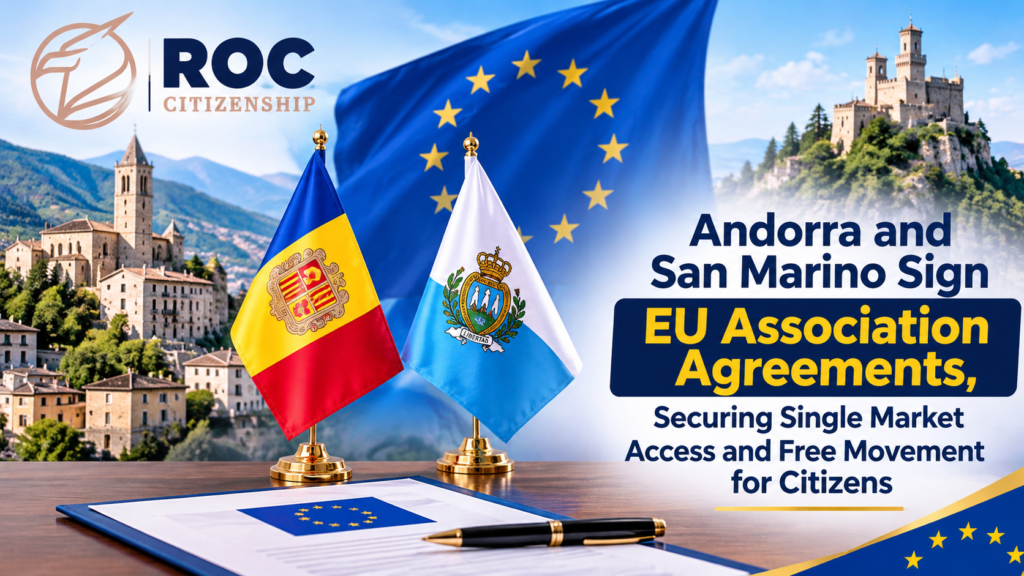
Andorra and San Marino signed association agreements with the European Union on 19 October 2026, granting both microstates access to the EU Single Market and expanding mobility rights for their citizens. However, the agreements do not grant EU or Schengen membership, and their existing tax systems and residence-by-investment routes remain unchanged.
Tax Regimes and Residence Routes Remain Unchanged
The agreements do not affect either country’s existing tax framework. Andorra maintains its maximum 10% personal income tax rate, while San Marino retains its current tax structure and special regimes for foreign residents, including its 7% substitute tax on foreign income for atypical residents. Both countries will continue to control their national tax policies, although they have committed to international tax transparency and cooperation.
For non-EU nationals, existing residence routes also remain in place. Andorra’s passive residence route continues to require a €1 million investment and a non-refundable €50,000 state contribution, while San Marino’s elective residence route retains its requirements of a €500,000 property purchase or €600,000 investment in government bonds. Importantly, residence in either country does not grant foreign nationals the right to live and work across the EU.
EU Citizens Gain Residence Rights Subject to Annual Quotas
EU nationals will benefit from expanded residence rights in both countries under the agreements, although access will remain subject to annual quotas. Andorra plans to introduce three separate quotas covering economically active residents, passive residents, and seasonal workers. These quotas are expected to be conservative and lower than the number of permits issued in recent years.
San Marino will allow its working EU-national population to grow by 3% annually, equivalent to approximately 100 additional permits, while a smaller quota will apply to non-working residents. Both countries will also retain the right to restrict property purchases by non-residents.
Free Movement Rights for Andorran and Sammarinese Citizens
Citizens of Andorra and San Marino will gain the right to live, work, study, retire, and establish businesses across the EU under the same conditions as EU nationals. This represents a significant expansion of their mobility rights, particularly for those who do not hold a second citizenship.
However, the agreements do not grant either country’s citizens EU citizenship or voting rights, and neither country will become part of the Schengen Area. Foreign residents seeking EU-wide mobility would still need to acquire citizenship, which generally requires 20 years of residence in both countries. Andorra also does not permit dual nationality.
Implementation and Next Steps
Neither agreement has entered into force yet. Both require European Parliament consent and ratification by EU member states. Andorra must additionally obtain approval from its co-princes and hold a consultative referendum, potentially in January. San Marino’s approval process may also face complications due to an ongoing financial and legal dispute involving a Bulgarian company.
Until the agreements are fully approved and implemented, existing residency rules will continue to apply to applicants of all nationalities, including EU citizens.
Summary
The agreements represent an important step towards closer economic integration between Andorra, San Marino, and the EU. While Andorran and Sammarinese citizens will gain EU-wide free movement rights, foreign residents will not receive the same benefits. For investors and non-EU applicants, the key takeaway is that both countries’ existing tax advantages and residence-by-investment routes remain unchanged, with no automatic access to EU mobility through residency alone.

