
In a move that could reshape the U.S. investment immigration landscape, the Department of Homeland Security (DHS) has proposed a sweeping reduction in filing fees under the EB-5 Immigrant Investor Program. The draft rule, released after a long-anticipated fee study mandated by the EB-5 Reform and Integrity Act (RIA), marks a significant policy shift following more than a year of elevated costs that have drawn sharp criticism from investors and regional centers alike. The new proposal aims to address what DHS itself acknowledges were disproportionate charges and administrative inefficiencies introduced in the 2024 fee schedule.
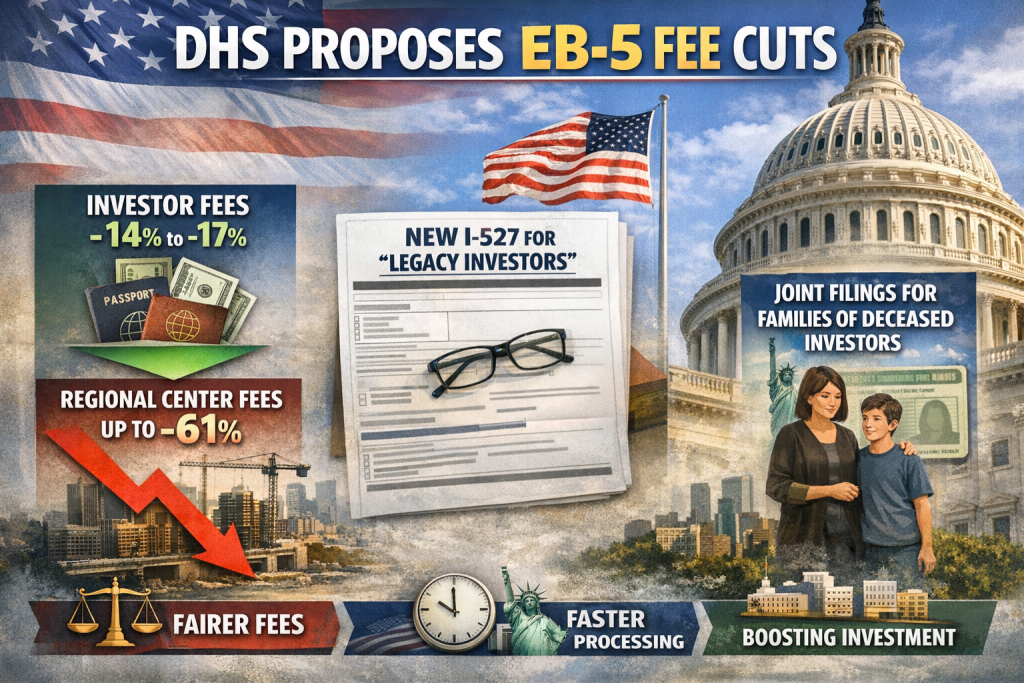
Under the proposed revisions, EB-5 investor filing fees would be reduced by 14–17%, offering meaningful relief to individuals pursuing U.S. permanent residency through investment. Meanwhile, regional centers and project-related filings could see an even more dramatic decrease of up to 61%, signaling a major recalibration of the program’s cost structure. Beyond financial adjustments, DHS also seeks to resolve long-standing procedural challenges. The agency has introduced a new Form I-527 specifically for “legacy investors” — those who filed the old I-526 petition before March 15, 2022 — to preserve their eligibility in cases where regional centers have since been terminated or debarred. Another important correction allows dependents of deceased principal investors to jointly file a single Form I-829 to remove conditions on their green cards, closing a regulatory gap that previously left many families in limbo.
A Long-Awaited Correction to EB-5 Costs
Industry experts view this proposal as a long overdue but welcome development. According to immigration attorney Matthew Galati, the fee reduction represents a “pleasant but overdue correction” and demonstrates DHS’s recognition that applicants were overcharged under the 2024 schedule. The new fee structure, Galati explains, aligns more closely with the financial parameters set by the EB-5 Reform and Integrity Act and strengthens claims in ongoing litigation — such as Moody v. Mayorkas — which argue that the previous fee rule failed to comply with statutory standards.
By recalibrating these fees, DHS implicitly acknowledges that it already possesses sufficient resources to manage and adjudicate EB-5 cases efficiently, challenging the justification for the inflated fees imposed last year. The move is widely interpreted as a step toward restoring fairness and transparency in program administration — two issues that have long undermined investor confidence in the EB-5 process. For many stakeholders, this proposal signals that the government is listening to industry feedback and is serious about rebuilding trust in the system.
Restoring Confidence and Investor Participation
From a broader policy perspective, the proposed fee cuts could play a crucial role in revitalizing the EB-5 program. By lowering financial barriers, the DHS aims to attract a new wave of investors who were previously discouraged by high costs and procedural uncertainty. Industry observers believe that the adjustment could help restore confidence in the EB-5 market and reenergize regional centers, particularly those managing projects that rely on predictable capital inflows.
However, the reform may also spark frustration among those who already filed under the higher 2024 fees and continue to endure lengthy processing delays. These investors, who effectively bore the brunt of the last fee hike, may feel left behind as newer applicants benefit from more favorable conditions. The key question now is whether DHS will pair the fee reductions with improved adjudication timelines — a critical factor that continues to influence investor sentiment.
What Happens Next
The public comment period for the proposed rule begins on October 23, giving stakeholders 60 days to provide feedback before the final implementation phase. If approved, the new fees could take effect shortly thereafter, potentially as soon as early 2026. The DHS’s responsiveness during this phase will be closely watched by attorneys, developers, and investors across the EB-5 ecosystem, all of whom are eager to see whether the proposal translates into tangible improvements.
Ultimately, this development represents a significant turning point for the EB-5 program. After years of regulatory uncertainty, backlogs, and rising costs, the government’s willingness to reconsider its fee structure suggests a renewed commitment to keeping the program competitive, transparent, and accessible. If implemented effectively, these changes could not only revive investor participation but also help reinforce the EB-5 program’s role as a cornerstone of U.S. economic development through foreign investment.
In summary
The DHS’s proposed EB-5 fee cuts mark a long-awaited correction that could reduce costs by as much as 61% for regional centers and 17% for investors. While the initiative aims to restore balance, fairness, and investor confidence, its success will ultimately depend on how efficiently DHS implements the changes and whether it can deliver faster, more predictable processing for the EB-5 community.

